
Updated: 15-10-2026
Added: 15-09-2025
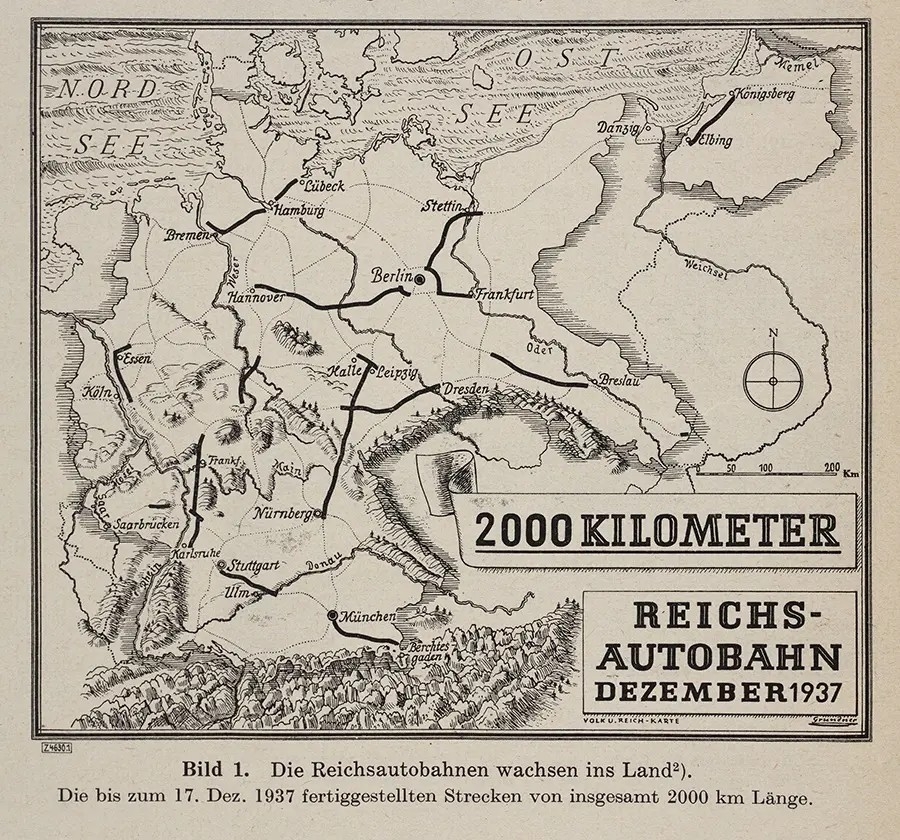
The construction of the Reichsautobahnen (RAB) motorway system was one of the most important economic projects in the Third Reich. Between 1933 and 1939, 4,000 kilometres of autobahn highways were opened in Germany. The plan to create a major regional network connecting major cities took on new significance with the outbreak of war. In the autumn of 1939, plans began for the construction of the so-called eastern route – the Oststrecken – through the western territories of occupied Poland. A project with top priority was a motorway connecting Frankfurt (Oder) with Poznań (with an extension to Łódź and Warsaw), which was to integrate the conquered territories with the central road network in the so-called Old Reich.
Beginning in late 1940, forced labour camps, known as Reich motorway camps (Reichsautobahnlager or RAB), began to be established with the aim of concentrating future forced labourers. A shortage of German workers, who were largely subject to compulsory military service, forced the Nazi authorities to take on prisoners of war and Jews.
In November 1940, Ernst Kendzia, the Reich's trustee for labour in the Wartheland region (Reichstreuhänder der Arbeit für Wartheland), entrusted the recruitment of Jewish workers directly to the German ghetto administration (vide). In the ghetto, the Recruitment Office (Arbeits-Einsatz II; see) was responsible for supplying workers and coordinating departures. Work outside the ghetto (vide) provided a greater chance of survival for many of its inhabitants, given the lack of employment within the ghetto.
As the war increasingly looked unfavourable for the Third Reich, the autobahn motorway project from Frankfurt (Oder) to Poznań was abandoned in June 1942. Despite the start of many road projects, none of them were ever completed.
It is estimated about 10,000 Jews from the Łódź Ghetto and other ghettos in Wartheland were deported to work on the highway projects.
Beginning in late 1940, forced labour camps, known as Reich motorway camps (Reichsautobahnlager or RAB), began to be established with the aim of concentrating future forced labourers. A shortage of German workers, who were largely subject to compulsory military service, forced the Nazi authorities to take on prisoners of war and Jews.
In November 1940, Ernst Kendzia, the Reich's trustee for labour in the Wartheland region (Reichstreuhänder der Arbeit für Wartheland), entrusted the recruitment of Jewish workers directly to the German ghetto administration (vide). In the ghetto, the Recruitment Office (Arbeits-Einsatz II; see) was responsible for supplying workers and coordinating departures. Work outside the ghetto (vide) provided a greater chance of survival for many of its inhabitants, given the lack of employment within the ghetto.
As the war increasingly looked unfavourable for the Third Reich, the autobahn motorway project from Frankfurt (Oder) to Poznań was abandoned in June 1942. Despite the start of many road projects, none of them were ever completed.
It is estimated about 10,000 Jews from the Łódź Ghetto and other ghettos in Wartheland were deported to work on the highway projects.
Jacek Walicki, Andrzej Grzegorczyk
Resources
M. Diefenbach, M. Maćkowiak, Praca przymusowa i autostrada między Frankfurtem nad Odrą a Poznaniem 1940–1945. Niemieckie nazistowskie obozy pracy dla Żydów, sowieckich jeńców wojennych, więźniów policyjnych i innych pracowników przymusowych wzdłuż budowanej Autostrady Rzeszy, Frankfurt (Oder)–Poznań: Institut für angewandte Geschichte – Gesellschaft und Wissenschaft im Dialog, 2017; K. Lärmer, Autobahnbau in Deutschland 1933 bis 1945. Zu den Hintergründen, Berlin: Akademie-Verlag, 1975; A. Ziółkowska, Obozy pracy przymusowej dla Żydów w Wielkopolsce w latach okupacji hitlerowskiej (1941–1943), Poznań: Wydawnictwo Poznańskie, 2005.